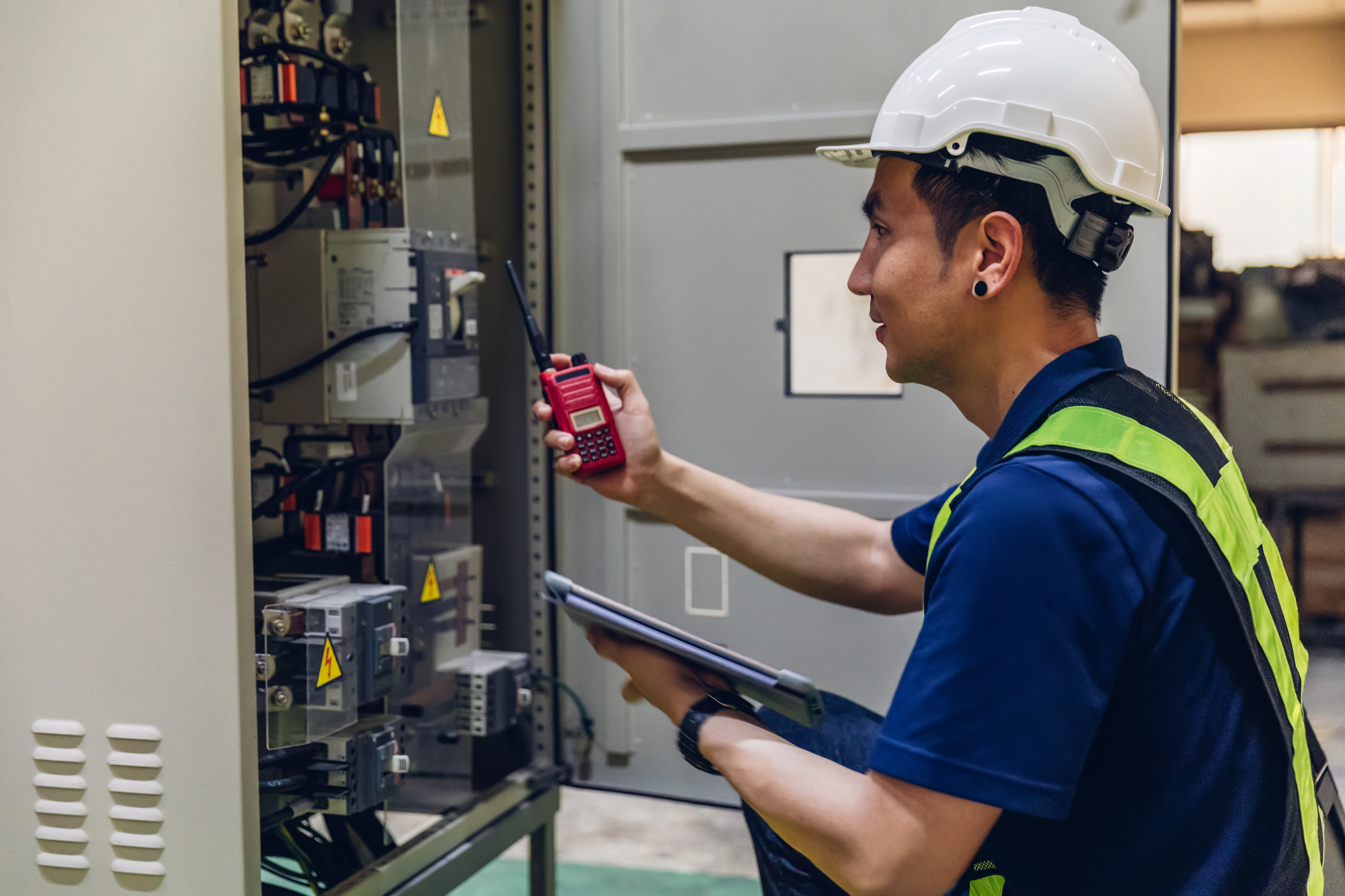
A commercial electrical maintenance schedule sets out every electrical task on a site, who performs it and how often it happens. At minimum it should cover switchboard and distribution inspections, lighting, fixed wiring and power circuits, safety devices, portable equipment testing, emergency lighting and the site’s solar or EV charging assets, each on its own interval.
Most Adelaide businesses do not have a schedule. They have a phone number they call when something stops working. That approach hides the cost of electrical faults inside downtime, spoiled stock and after-the-fact repairs, and it leaves compliance evidence scattered across old invoices. A written schedule turns that into a planned, budgeted line item.
What Is a Commercial Electrical Maintenance Schedule?
It is a document, not a habit. A schedule lists each electrical asset or system on the premises, the maintenance task attached to it, the interval it repeats on, and the record that proves the work was done.
Three things separate a real schedule from a maintenance wish list:
- every task names the asset it applies to, not just the building
- every task has a stated interval and a responsible party
- every completed task produces a dated record kept on site
That last point is the one that matters when an insurer, a landlord or a regulator asks what has been done. A schedule without records is an intention.
Why Does Scheduled Electrical Maintenance Matter for Adelaide Businesses?
Because electrical faults rarely appear without warning. They announce themselves through nuisance tripping, warm switchboard components, flickering lights on one circuit and equipment that resets under load. Preventive electrical maintenance catches those signals while they are still cheap to resolve.
Adelaide adds its own pressure. Summer heat loads push air conditioning, refrigeration and switchboards hard for months at a time, and a board that copes in April can run hot in January. Sites that have added solar, battery storage or EV charging since the original fit-out are also drawing and exporting in ways the switchboard was never designed around.
Under South Australian work health and safety law, a business must maintain its electrical installation and equipment in a safe condition. SafeWork SA publishes the current duties for electrical safety at work: see SafeWork SA — electrical safety.
What Should a Commercial Electrical Maintenance Schedule Cover?
Group the schedule by system rather than by trade. That way nothing falls between contractors.
Switchboards and Distribution Boards
The switchboard is where most preventable commercial faults start. A scheduled inspection looks for heat discolouration on terminals, loose or shared neutrals, undersized or overloaded circuits, missing circuit labelling, and boards that have accumulated additions from several different tradespeople over the years.
Older boards with ceramic fuses or no residual current devices are a replacement conversation, not a maintenance one; NG Elec covers that under switchboard upgrades.
Lighting and Emergency Lighting
Commercial lighting maintenance covers failed lamps and drivers, sensor and timer settings that no longer match how the space is used, and exterior and car park lighting that only gets noticed in winter. Emergency and exit lighting is a separate obligation with its own testing interval under AS/NZS 2293, and it is the item most often missed on tenanted sites where no one has claimed ownership of it.
Fixed Wiring, Power Points and Circuits
Scheduled checks on fixed wiring pick up damaged outlets, overloaded circuits feeding equipment added since the fit-out, cabling run to temporary locations that became permanent, and power points in wet or dusty areas that have degraded. Layout changes are the usual trigger: a workstation that moved two years ago is often still fed by an extension lead.
Safety Devices and Protective Equipment
Residual current devices, circuit breakers and surge protection all need periodic verification rather than assumption. Push-button testing of RCDs is a simple in-house task that can be scheduled monthly or quarterly. Instrument-based RCD trip-time testing and portable appliance testing to AS/NZS 3760 are specialist services with defined intervals based on the environment, an office fits a longer interval than a workshop or kitchen.
Site Equipment, Machinery and Layout Changes
Any equipment with a motor, an element or a compressor belongs on the schedule, along with the supply feeding it. New machinery, a new tenancy fit-out or a change of use should trigger a review of the supply capacity rather than a straight connection to whatever circuit is nearest.
Solar, Battery and EV Charging Assets
Sites with a commercial array need inverter fault logs, output monitoring, DC isolator condition and panel cleanliness on a set interval, NG Elec handles this through solar repair and maintenance and solar panel cleaning. EV chargers installed for staff or customer use need their own checks on the charger, the supply and the load management settings.
How Often Should Each Task Happen?
Intervals depend on the environment, not the calendar. A dusty workshop, a commercial kitchen and a quiet office with the same floor area need different frequencies. As a starting structure for an electrical maintenance plan:
| Interval | Typical tasks |
|---|---|
| Monthly or quarterly | In-house visual checks: damaged leads and outlets, RCD push-button tests, lamp failures, anything running warm or noisy |
| Six-monthly | Emergency and exit lighting testing (AS/NZS 2293), switchboard visual inspection, exterior and car park lighting review |
| Annually | Full switchboard inspection, fixed wiring and circuit review, RCD trip-time testing, solar system service, capacity review against current site load |
| On change | Any new equipment, tenancy change, fit-out, added solar, battery or EV charging, review supply and protection before connection |
| Portable equipment | Interval set by environment under AS/NZS 3760, shorter in workshops, kitchens and construction environments than in offices |
Write the intervals down once and the schedule largely runs itself. The common failure is a site that tests portable equipment diligently and has not opened the switchboard in eight years.
What Gets Missed Most Often?
Four items account for most of the gaps on Adelaide commercial sites:
- emergency and exit lighting on tenanted premises, where responsibility sits between landlord and tenant
- circuit labelling, which quietly stops matching reality after the second or third alteration
- supply capacity after equipment is added, the new machine works, so nobody checks the headroom
- records, which exist as invoices in an inbox rather than a maintenance log on site
Labelling is worth singling out. An unlabelled board turns a ten-minute isolation into an hour of guessing, and that hour is charged at the worst possible moment.
Who Should Carry Out the Work?
Visual checks and RCD push-button tests can sit with site staff. Everything involving the switchboard, fixed wiring or protective devices belongs with a licensed commercial electrician in Adelaide. Specialist testing services such as portable appliance testing and instrument-based RCD testing are often engaged separately, so confirm with each provider exactly which items on the schedule they are covering.
NG Elec provides commercial electrical maintenance covering repairs and fault finding, power point upgrades and rewiring, lighting replacements and sensor installations, electrical safety checks, system adjustments for equipment or layout changes, and troubleshooting for power disruptions. Ongoing maintenance across multiple properties is handled through property maintenance, and all workmanship carries a lifetime warranty. Discounts apply to scheduled maintenance.
The point of the schedule is that the same contractor sees the same site repeatedly and knows what changed since last visit. That continuity is what turns maintenance from a cost into a forecast.
Book Commercial Electrical Maintenance in Adelaide
A commercial electrical maintenance schedule is only useful once it is written down and someone is booked to deliver it. NG Elec works with Adelaide businesses and property managers to build a schedule around the site as it is now, not as it was at fit-out, and to keep the records that go with it. Quotes are free and scheduled maintenance attracts a discount. Call NG Elec on 0425 322 552 or get in touch to set your maintenance schedule for the year ahead.
Frequently Asked Questions
How often should commercial electrical maintenance be done?
Most Adelaide commercial sites work to a layered schedule: in-house visual checks monthly or quarterly, emergency lighting and switchboard inspections six-monthly, and a full electrical inspection annually. Higher-risk environments such as kitchens, workshops and warehouses need shorter intervals than offices.
What is included in a commercial electrical maintenance schedule?
A complete schedule covers switchboards and distribution boards, lighting including emergency and exit lighting, fixed wiring and power circuits, safety devices such as RCDs and circuit breakers, portable equipment testing, and any solar, battery or EV charging assets on site. Each item gets its own interval and a dated record.
Is electrical maintenance a legal requirement for businesses in South Australia?
Under work health and safety law, a business must ensure its electrical installation and equipment are maintained in a safe condition, and specific standards apply to items such as emergency lighting and in-service testing of portable equipment. SafeWork SA publishes the current duties and is the correct source to check against.
How much does commercial electrical maintenance cost?
Cost depends on the size of the site, the number of assets on the schedule and the intervals chosen. Contact NG Elec directly for an accurate quote — all pricing is confirmed before any work begins, with no obligation to proceed.
Can one electrician cover the whole maintenance schedule?
A licensed commercial electrician can cover installation, switchboard, wiring, lighting and fault work, while some compliance testing services are commonly engaged as specialist tasks. Confirm in writing which schedule items each provider is responsible for so nothing is assumed to be covered.
Does adding solar or EV charging change the maintenance schedule?
Yes. New generation or charging load adds inverter checks, isolator inspections, panel cleaning and charger servicing to the schedule, and it usually warrants a switchboard capacity review. These should be added at installation rather than at the next annual inspection.